 |
|
|
|
 |
|
|||||
|
|
||||||




|
The Maple Story Sap to Syrup Syrup is produced by evaporating (cooking) the sap until it is 66% solids (sugar). This evaporation requires 42 gallons of sap if the sap is 2% sugar. If one gets lucky and gets 3% sugar in the sap it takes 29 gallons of sap to get 1 gallon of syrup. Light colored syrup is usually produced in the season’s beginning gradually becoming darker as the season progresses. Syrup to Pure Maple Cream The syrup must continue
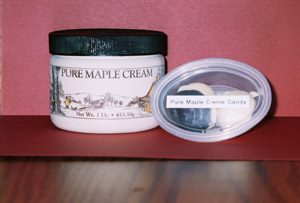
cooking in order to make pure Maple Cream or Maple Butter. Maple Cream
is pure maple. It does not contain any other ingredients and is cooked
until it is creamy (230 degrees F.). Maple Cream is used on toast,
English muffins, and bagels, to eat out of the jar, on a peanut butter
sandwich and frosting. Maple Cream that is cooked more (240 degrees
F.) is stiffer and is used to make Maple Candy Creams. This cream
holds its form. Maple Cream To Maple Sugar Candy Maple Cream is turned into Maple Sugar Candy by cooking it to a sugar consistency. Some moisture remains but is getting closer to the maple sugar, but can be molded or formed. Maple Sugar
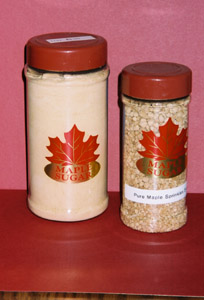
The Maple Story concludes with the production of Maple Sprinkles. When using a creaming machine for the above processes, small hard balls form. These are extracted and smashed to small particles or “maple beads” commonly called “sprinkles”. This is a versatile pure maple product used on hot cereals, as a topping on ice cream, on squash, and in pancake, muffin, cake, and cookie batters. They are like mini “maple chips”. Using the spout as the starting point, the approximate 3 week trip from the tree to the table is a very hard, exciting trip, but an incredible gift from Mother Nature. |
||
| |
||
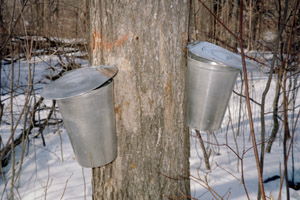 The
Maple Story starts in late February or March each year. A spout is
put into a maple tree - usually a sugar maple tree, but soft maples
have sweet sap also.
The
Maple Story starts in late February or March each year. A spout is
put into a maple tree - usually a sugar maple tree, but soft maples
have sweet sap also.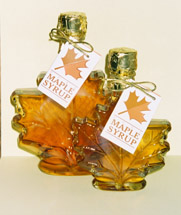
 The
consistency becomes granulated by additional cooking. Maple Sugar
is used as any sugar but is better for you and has less calories that
white sugar. It is commonly used on toast, especially cinnamon raison
toast, coffee, hot cereals, and in cooking and baking.
The
consistency becomes granulated by additional cooking. Maple Sugar
is used as any sugar but is better for you and has less calories that
white sugar. It is commonly used on toast, especially cinnamon raison
toast, coffee, hot cereals, and in cooking and baking.